What a CV summary should say, how long to make it and what to leave out, with labelled examples for experienced candidates, career changers and graduates.
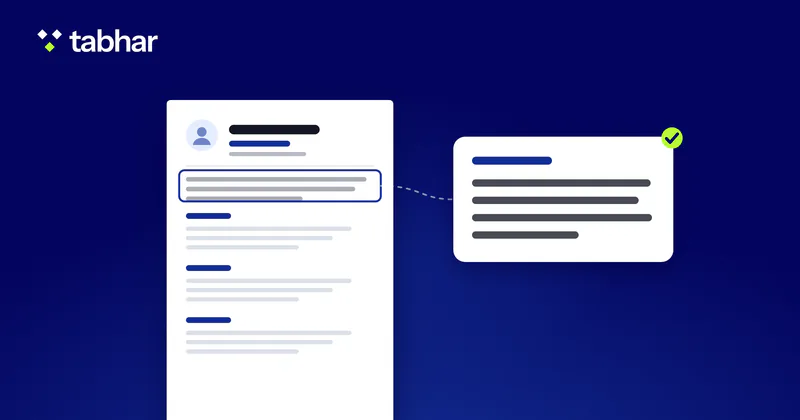
The summary is the short paragraph at the top of your CV, just below your name and contact details. It goes by several names, including professional summary, personal profile and personal statement, and because of where it sits it is one of the first things a recruiter sees. A good summary tells the reader, in a few lines, who you are professionally and why you fit this particular job.
This guide covers what to include, how long to make it, how to adapt it for each application and what to leave out. It includes labelled examples for three common situations: an experienced professional, a career changer and a recent graduate.
What a CV summary is, and when you need one
The UK government's National Careers Service describes the CV introduction as a brief statement, a few lines long, of who you are and what you want to do next, sitting directly below your name and contact details. The UCLA Career Center adds a key word: tailored. A summary should present your qualifications for one particular job, not for every job.
A summary is not compulsory. UCLA notes that a resume does not have to include one, and Prospects, the UK graduate careers website, notes that opinions differ on whether one is needed. It earns its place when:
- Your background does not obviously match the role. UCLA suggests using the summary to connect your relevant experience, skills and qualifications to the role in terms the employer will recognise, which is exactly what a career changer needs.
- You are not sending a cover letter. In that case, UCLA notes, the summary can do some of the work of a brief cover letter.
- You have plenty of experience to condense. Prospects reports that some recruiters think summaries suit CVs with more work experience, where a clear overview saves the reader from piecing your profile together.
- Summaries are the norm in your field. UCLA lists this as a reason in itself.
A summary is also different from an old-style career objective. As UCLA explains, your goal is already obvious from the job you are applying for. The summary's job is to show what you offer.
Why the top of the page matters
Recruiters read fast. The National Careers Service notes that employers receive many CVs and must make quick decisions about whom to interview, and Prospects says employers give application documents only a few seconds.
An eye-tracking study by the job site Ladders, updated in 2018, found an average initial screen of 7.4 seconds. The CVs that held recruiters' attention best shared several traits, including a detailed overview or mission statement at the top of the first page, and recruiters skimmed for details such as layout, job titles and keywords. One study by one company is not the final word on how every recruiter reads, but it points the same way as careers-service advice: make the top of your CV easy to take in, and open your summary with the professional title you are applying as.
How long should it be?
Short. The advice from careers services is consistent:
| Source | Recommended length |
|---|---|
| University of Arizona Center for Career Readiness | 2–3 sentences, about 2–3 lines on the page |
| Prospects (UK) | No longer than 150 words |
| National Careers Service (UK) | A few short lines |
In practice, aim for two or three lines and treat 150 words as an upper limit, not a target. If your summary needs more room than that, it is probably repeating your experience section, which the University of Arizona specifically advises against.
What to put in it: four building blocks
A strong summary usually answers four questions, in this order.
- Who are you professionally? Your professional title and field, plus your level of experience if it helps. Where it is honest, use a title that matches the job you are applying for.
- What are you best at that this employer needs? Two or three skills or specialisms taken from the job description, not a generic list. UCLA advises describing your experience in the words the job posting uses, and sticking to the skills and qualities the employer has actually asked for.
- What is your proof? One concrete achievement, with a real number if you have one. Prospects recommends backing up your skills with evidence, briefly.
- Where are you heading? Optional and short: the kind of role or next step you want, phrased around what you bring.
First person, third person or neither?
Conventions differ. Prospects accepts either the first or the third person, provided you stick with the one you choose. UCLA suggests dropping full sentences altogether, which avoids both "I" and third-person references. For most English CVs the compact style without "I" is the safest choice, such as "Project engineer with six years in road construction". Whichever style you choose, keep it consistent from the first word to the last.
Examples for three situations
These examples describe hypothetical people. Borrow the structure, not the content, and fill your own summary with your own real facts and numbers.
Experienced professional
Example (hypothetical). Procurement specialist with eight years in construction supply chains across the Gulf. Runs tenders from request to award, negotiates supplier contracts and works closely with site teams on delivery schedules. Cut average purchase-order turnaround from ten days to six by introducing a standard approval workflow. Looking to lead a category team at a major contractor.
Why it works: the title and field come first, the skills are the ones a procurement role asks for, and one specific result does more than a line of adjectives.
Career changer
Example (hypothetical). Secondary-school mathematics teacher moving into data analysis. Six years of turning assessment results into clear reports for school leaders, now backed by a completed data analytics certificate and three portfolio projects using SQL and Power BI. Experienced in explaining numbers to non-specialists and working to fixed deadlines.
Why it works: it names the change in the first line, leads with transferable skills, and points to evidence of the new direction (training and projects) instead of asking the reader to take it on trust. The University of Arizona suggests asking yourself which transferable skills link experiences that look unrelated at first glance; that question sits at the heart of a career-change summary.
Recent graduate
Example (hypothetical). Civil engineering graduate (2026) with a final-year project on stormwater drainage design and a ten-week site internship with a regional contractor. Comfortable with AutoCAD and quantity take-offs, and used to reporting daily progress to a site manager. Seeking a graduate site engineer role.
Why it works: with little work history, it leans on education, a project and an internship. That matches the advice from Prospects for graduates to lead with their studies and the direction they want their career to take. It also avoids the empty claims ("hard-working", "team player") that Prospects says make many graduate profiles bland and generic.
If this is your first CV, our guide to writing a CV with no work experience goes further.
Tailor it to each job
The summary is the easiest part of your CV to adapt, and the part where adapting shows most. Prospects recommends drawing on the job description when you write your profile and adjusting it for every application. A simple routine:
- Keep a master version with your title, core strengths and best evidence.
- For each application, mark the three or four requirements the advert stresses most.
- Reorder or swap your skills so that the ones the employer asks for come first, using the advert's wording where it genuinely describes what you do.
- Choose the achievement that best proves the most important requirement.
- Check that everything in the summary is backed up, with evidence, further down your CV.
Use keywords naturally. In the Ladders study, a reliance on keyword stuffing was one of the traits of the weakest CVs. Write your summary for the person who will read it, and let the keywords come from what you have really done. Our guide to ATS-friendly CVs explains how applicant tracking systems handle keywords. If you are applying in the Gulf, the Gulf CV guide covers regional details, such as mentioning your notice period near the top or in your summary.
What to leave out
- Clichés and empty claims. "Results-driven team player with excellent communication skills" could describe anyone. Prospects points out that generic statements of this kind tell an employer nothing about what you can actually do. Replace each one with something specific you have done.
- Copied text. Prospects advises against copying from your cover letter or from online examples, because your summary should be yours alone. The same goes for AI output: use it for wording at most, and check every fact (see how to use AI to write your CV without inventing anything).
- A wish list. A line about what you want from an employer, with nothing about what you offer, is an objective, not a summary.
- A repeat of the sections below. The University of Arizona advises against restating basic details the reader will find in the sections directly underneath.
- Anything you cannot back up. Every claim in your summary should be supported elsewhere in your CV, and you should be able to discuss it in an interview.
- Errors. Prospects notes that any spelling or grammar mistake in the summary stands out at once, given its position at the top of the page.
A quick checklist
- It opens with a professional title that fits the job.
- It runs to two or three lines, well under 150 words.
- It names two or three skills from the job description.
- It includes one specific, true achievement.
- The voice is consistent throughout.
- It contains no clichés, copied text or errors.
How Tabhar helps
In Tabhar's CV builder, the live editor shows your summary on the printed page as you write, so you can see straight away whether it runs to two lines or six. Changing template never changes your content, so you can try different designs without rewriting anything.
On paid plans, AI writing help can shorten, expand or rewrite your summary. Each suggestion appears as a before and after and changes nothing until you accept it, and a number in a suggestion that is not in your CV is flagged. To adapt your CV for a specific role, you can tailor it to a saved job and accept or reject each suggestion, then use the free ATS checker to see how your CV matches a job title and description. Compare plans to see what each one includes.
Related reading
- How to use AI to write your CV without inventing anything
- Which skills to put on a CV, and how to prove them
- Writing a CV with no work experience
Sources
- How to write a CV — National Careers Service (2026)
- How and When to Write a Professional Summary — UCLA Career Center (2026)
- Writing a personal statement for your CV — Prospects (2025)
- Ladders Updates Popular Recruiter Eye-Tracking Study — Ladders, via PR Newswire (2018)
- Writing a Resume Summary Statement — University of Arizona Center for Career Readiness (2022)