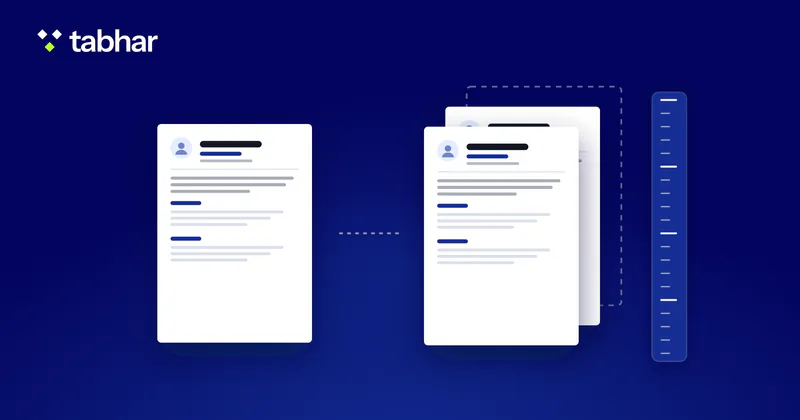
One page, two or more? The usual CV length by career stage and country, when a longer CV is right, and how to cut one down without losing what matters.
For most jobs, a CV of no more than two pages is the norm, and one page is usually enough early in your career. The main exceptions are academic, research and medical CVs, which run as long as the record they describe. That is the short answer; the useful detail is in the exceptions, and in how to cut a CV that has grown too long without losing the evidence that gets you shortlisted.
This guide sets out the usual length by career stage and by country, what the sources disagree on, and how to shorten a CV the right way.
The short answer, by career stage
| Your situation | Usual length | What the sources say |
|---|---|---|
| Student, graduate or first job | One page | The University of Sharjah’s careers office says one page will suffice for students with little or no experience, and Reed calls a one-page CV perfectly fine for a recent graduate. |
| Most experienced candidates | Up to two pages | The UK government’s JobHelp puts the ideal length at no more than two sides of A4; Michael Page calls two pages widely considered the perfect length. |
| Senior and executive roles | Usually two; three only when the experience demands it | Prospects says a three-page CV might be needed for high-level roles; Robert Half says most executive resumes should be one to two pages, with three sometimes appropriate for chief executives with board experience, but generally not recommended. |
| Academic, research and medical CVs | As long as the record requires | The University of Oxford’s careers service says an academic CV has no page limit, though it should stay concise and relevant; MIT puts a typical academic CV at 2 to 4 pages for a younger professional and 4 to 7 for someone with more experience. |
The sources disagree at the top of the ladder. Michael Page allows up to four pages if needed for decades of experience, while a recruiter eye-tracking study from Ladders recommends a strict two-page limit for more experienced job seekers. If you are unsure, two pages is the length no source objects to.
Why length matters: the first read is short
In the same study, Ladders reported that the average initial screening of a CV took 7.4 seconds. It is one company’s research and the announcement gives no sample size, so treat the exact figure with care; the direction is what matters, and it matches the advice of every careers service in this guide. The University of Sharjah puts it plainly: your CV is not supposed to be a novel, and if the employer is not convinced after one or two pages, the next four are unlikely to change that.
The practical lesson is to put your strongest, most relevant evidence on the first page, where it is sure to be read. How applicant tracking systems read a CV is a separate question, covered in its own guide.
Length by country and region
United Kingdom. Two sides of A4 at most, per JobHelp. Some employers want less: the University of Oxford notes that some, such as investment banks, expect just one page.
United States and Canada. Here the document is usually called a resume, and the word CV means an academic CV; our guide to CV vs resume explains the difference. MIT’s resume checklist asks for one page, allowing two with an advanced degree or extensive experience of ten years or more. The Government of Canada’s Job Bank advises limiting a resume to two pages.
Europe. The EU’s job-mobility portal EURES says two pages is generally accepted as the ideal length.
The Gulf and the wider Arab world. We found no length rule on the official job portals we checked. The University of Sharjah’s careers office advises no more than two pages, and one page for students with little or no experience, and recruiter Michael Page’s Middle East site says ideally no more than two pages and never more than three. What else changes by region, such as the photo and personal details, is in our guides to CVs for the Gulf, Egypt and the Levant and the Maghreb.
How to cut a CV that runs long
- Focus on the last ten years. Michael Page suggests detailing your past ten years and summarising earlier positions by company, job title and dates; Canada’s Job Bank says experience more than 15 years old should be cut or minimised.
- Cut what does not serve this job. Prospects is blunt: if it is not relevant to the job you are applying for, delete it. EURES makes the same point: include only what this recruiter needs to know.
- Say each thing once. Reed warns how easy it is to make the same point several times in different words. Merge bullets that describe the same achievement.
- Keep each section short. Job Bank suggests five to seven bullet points per section.
- Drop hobbies that add nothing. Prospects and Reed both say to include hobbies only when they are relevant to the job.
- Question the references line. Advice differs. The University of Oxford says referees take up space and employers will assume you have them, and Prospects says to leave out “references available upon request” if you are short of space. The UK’s National Careers Service, on the other hand, says you can write that references are available on request. Either way, it is the first line to go when space is tight.
Do not shrink the text to fit
Squeezing a three-page CV onto two pages with a tiny font does not make it shorter; it makes it harder to read. Keep the text at a readable size: Prospects and MIT both give 10 to 12 points, and the National Careers Service says 11 or bigger. Keep reasonable margins too: Prospects suggests 2.5 centimetres all round and warns against making them smaller to fit more in. Reed adds that shrinking margins and changing the typeface to cram content in only makes a CV stand out for the wrong reasons.
When the employer asks for something else
An instruction in the job advert beats every rule of thumb. Harvard’s career centre says to follow the employer’s directions, and to submit a one-page resume if that is what they ask for; the University of Oxford advises checking whether the application guidance sets a page limit.
How Tabhar can help
The CV builder shows your CV as printed pages while you edit, so you can see the moment it spills onto a second or third page. The design panel lets you change the font size, line spacing and side margins, and switch between A4 and Letter paper; use them to tidy the layout, not to squeeze text below a readable size.
To tighten the words themselves, you can ask the AI assistant in the editor (AI writing help) for a shorter version of a line or a bullet. Every change is shown as a suggestion you review before it is applied, so you decide what stays. When the CV is ready, the free ATS checker shows how it matches a job title and description, and you can export it as PDF or Word.
Related reading
- CV vs resume: what is the difference?
- How to write a CV with no experience
- 20 common CV mistakes and their fixes
Sources
- Preparing your CV — JobHelp, UK Government (2026)
- How to write a CV — Prospects
- CVs — Careers Service, University of Oxford
- Resume checklist and worksheet — MIT Career Advising & Professional Development
- Curricula vitae (CVs) — MIT Career Advising & Professional Development
- Resumes & cover letters for PhD students — Harvard Mignone Center for Career Success
- How to write a good resume — Job Bank, Government of Canada (2024)
- From application to acceptance: top tips for securing a job — EURES, European Union (2019)
- Ladders updates popular recruiter eye-tracking study — Ladders, via PR Newswire (2018)
- How long should a CV be? — Reed (2025)
- How long should a CV be? — Michael Page UK
- How to write a great CV — Michael Page Middle East
- How to create a captivating executive-level resume — Robert Half
- Resume writing guidelines — University of Sharjah, CASTO
- How to write a CV — National Careers Service